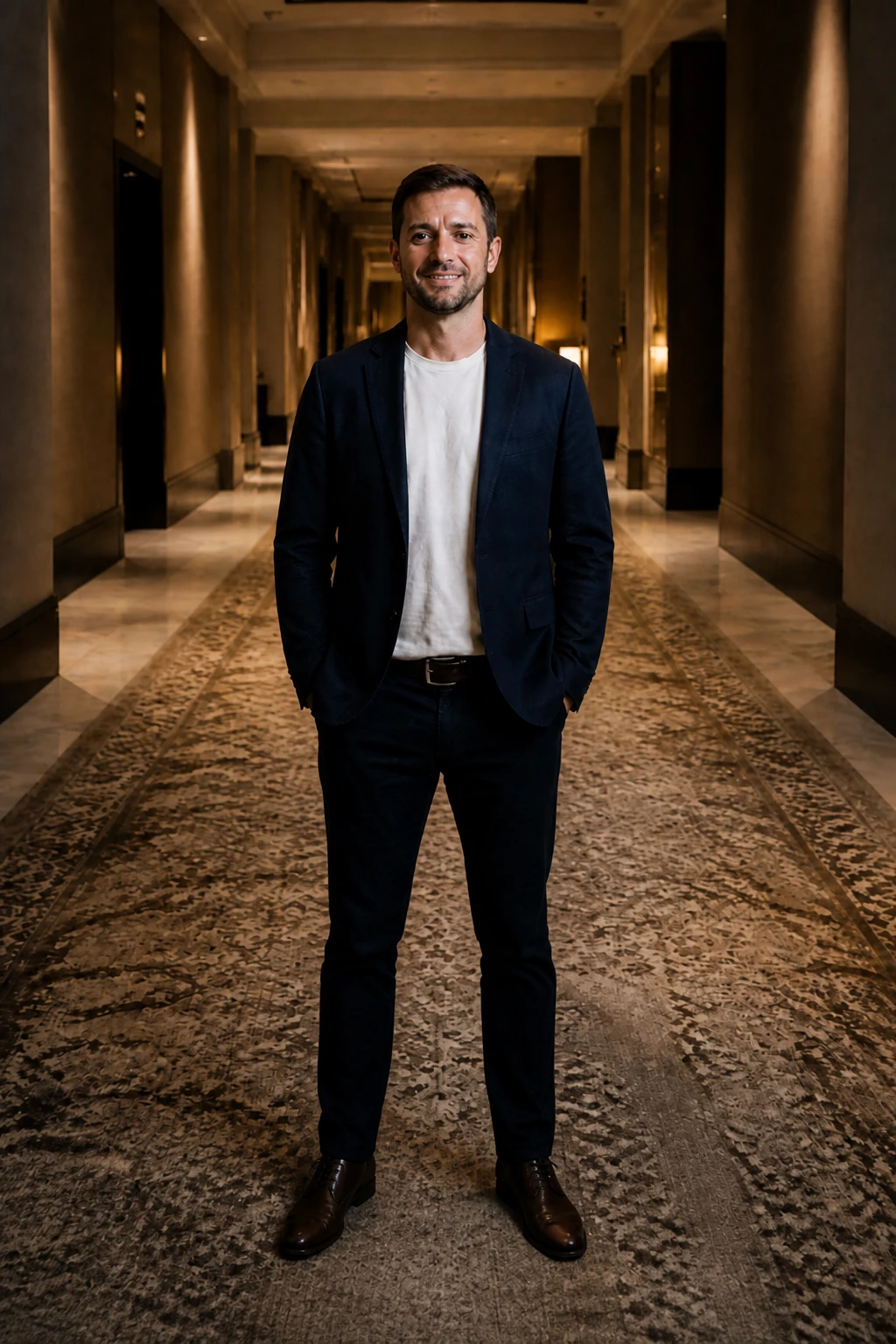
Bounced light is light that arrives via a surface — a wall, a ceiling, a reflector, a white card — instead of straight from the source. The surface becomes the effective light: its size sets the softness, its color tints the result, and its position, not the lamp's, decides the direction. Bounce is how photographers conjure big, soft sources out of small hard ones, and it is the working principle behind half the fill light in this library.
When to reach for it
Bounce when you need a bigger source than you own: a speedlight fired into a white wall becomes a wall-sized softbox. Bounce when gear must stay invisible — an event shooter aims the flash at the ceiling because a ceiling doesn't show in the frame. And bounce when you want fill that cannot be overdone: a passive surface has built-in modesty, which is the next point.
The physics that keeps bounce honest
A bounced surface can never out-shine the source that feeds it. The surface receives some amount of light, loses a fraction to absorption — even bright white paper reflects at most about 90% — and then scatters what remains over a half-sphere. The result always arrives dimmer than what left the lamp. This is worth internalizing because it works for you: build a fill from a card and physics itself guarantees the fill stays subordinate to the key. It is the one ratio mistake you cannot make.
The cost is efficiency and control: every bounce spends stops, and the surface throws light broadly. A silver surface returns more and stays more directional; a white one scatters softer and dimmer; a colored wall taxes your white balance — bounce is always a trade of power for size.
How to read it in a photograph
Bounced light has a signature: big, soft, and coming from somewhere no lamp would be. A portrait lit gently from a wall's direction, catchlights that are broad smears rather than crisp shapes, fill rising from below without a lamp's telltale second catchlight. On our sun-and-mirror portrait, the sun rims from behind while the face's front is lit entirely by a hand-held card redirecting that same sun — one source, two jobs, the second one bounced.
What people get wrong
Bouncing off the wrong color. The surface tints everything it sends: a cream ceiling makes warm skin, a green wall makes ill skin. Check the surface before trusting it.
Distance thinking. The subject's distance to the surface — not to the lamp — governs falloff and softness. Photographers move the flash and wonder why nothing changes; the surface is the light now, so move that relationship instead.
Expecting drama from bounce. Scattered light wraps and flattens by nature. If you need a hard, sculpted look, bounce is the wrong instrument — that work belongs to the direct key, with bounce relegated to filling its shadows.
In the library
Thirty setups author a bounced surface. Start here: Speedlight Bounce Event Portrait (the ceiling-and-wall craft), Speedlight Wall Bounce Corridor Portrait (a corridor wall as a soft key), and Hand Mirror Sun Fill Portrait (bounced sunlight as the entire frontal light).