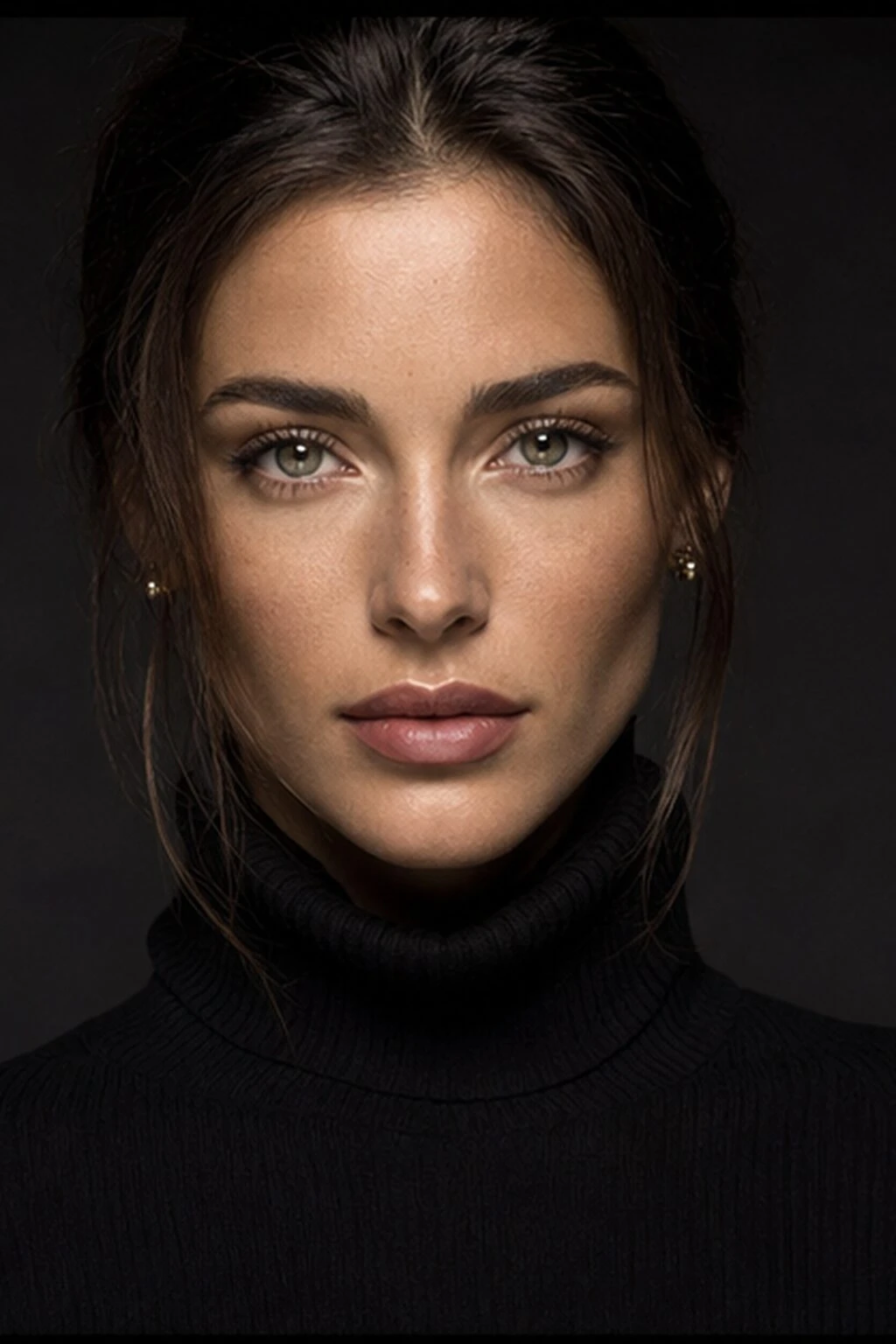
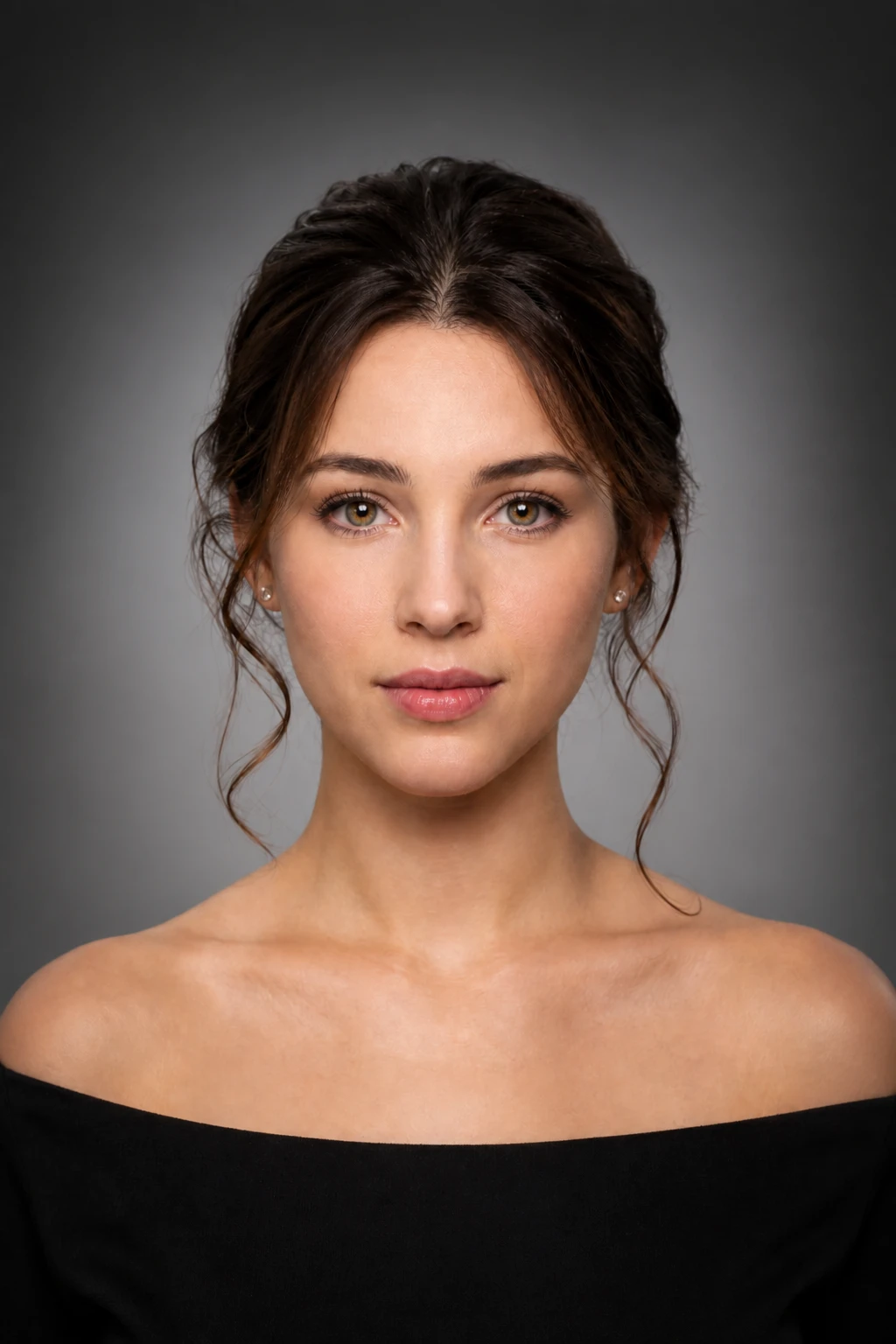
Butterfly lighting — also sold under its Hollywood name, Paramount — is a single key on the lens axis, raised above the face and angled down. Nothing sits beside the subject; the light's whole identity is height. Done right, it throws a small, symmetric shadow directly under the nose (the "butterfly" that names the pattern), matched shadows under both cheekbones, and a defined shadow under the chin.
When to reach for it
Butterfly flatters bone structure. Because the shadow falls straight down, it carves cheekbones and jawline without taking either side of the face dark — which is why it has been the glamour default since the studio era. It rewards strong, symmetric faces and even make-up. It punishes deep-set eyes (the sockets go dark fast as the key rises) and it cannot give you mood: if the brief says atmosphere or mystery, you want the key off-axis, walking toward Rembrandt territory.
How to identify it in a photograph
Symmetry is the test, and it must hold everywhere. On our canonical butterfly setup, the left–right difference measures 0.32 stops or less on all four axes — temple, cheek, jaw, and the base of the nose. A pattern that is symmetric at the cheeks but not at the nose is not butterfly; it is loop drifting on-axis. Then check the catchlights: one per eye, at 12 o'clock — a beauty dish is the classic source. If you see a second catchlight low in the iris, someone added a fill from below and you are looking at clamshell.
The under-chin shadow is the clearest cue of all, and our own library proves it: the same face lit butterfly measures +7.38 stops cheek-to-neck, against +0.65 stops for clamshell. One number, eleven-fold apart in linear light.
Our strongest demonstration of that cue is actually Soft Beauty Light Portrait — measured at four-axis symmetry within 0.34 stops with a clean under-nose shadow on an open neck. On the canonical setup the model wears a turtleneck, so the under-chin evidence is hidden there; we say that plainly rather than pretend the frame shows what it cannot.
What people get wrong
Height is the whole adjustment, and both directions fail differently. Too low, and the under-nose shadow vanishes — the face goes flat and the pattern dissolves into plain frontal light. Too high, and the shadow stretches down to the lip while the eye sockets fall into darkness: the "raccoon eyes" that make subjects look exhausted. The working band is roughly 30–45° above the lens axis; watch the nose shadow and stop when it is a butterfly, not a moustache.
The subtler failure is drift off-axis. Even 15° sideways slides the nose shadow toward one cheek, and the pattern quietly becomes loop. If the two cheek shadows stop matching, recentre the key over the lens before touching anything else.
In the library
Two published setups demonstrate butterfly: Butterfly Beauty Dish Portrait (canonical) and Soft Beauty Light Portrait, which carries the under-chin cue the canonical frame hides.