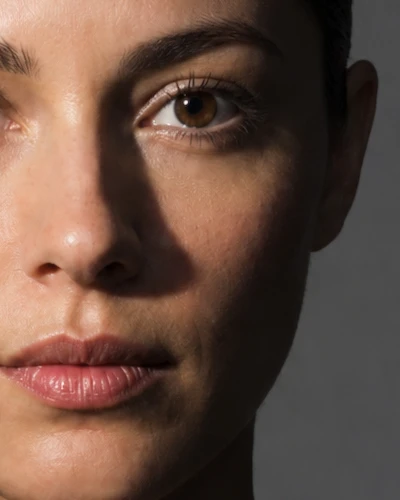
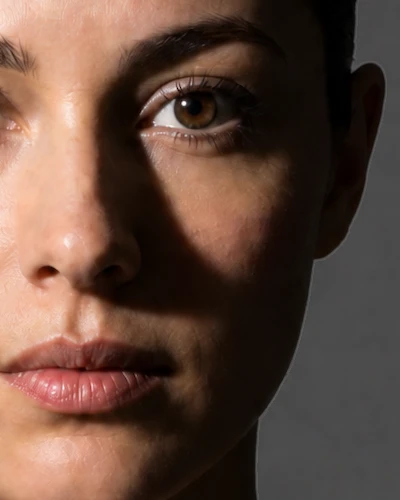
Rembrandt lighting is a single key set about 45° to the side of the camera and raised until two shadows meet: the nose shadow reaching down and sideways, and the cheek shadow reaching up. Where they join, they fence off a small lit patch on the shadow-side cheek — the Rembrandt triangle — and that closed patch of light, roughly the width of an eye, is the pattern's entire signature. One light, one triangle, and a face that keeps drama on one side without losing the eye on the other.
When to reach for it
Rembrandt is the character light. It gives weight and dimension that flat or frontal patterns cannot, which is why it owns male portraiture, editorial work, and any face that benefits from structure. Its cost is fragility: this is the least pose-tolerant of the classic patterns. Let the subject turn their head a few degrees and the triangle slides, shrinks, or dies — which is also why it rewards a photographer who watches the shadow side, not the key side.
How to identify it in a photograph
Find the shadow-side cheek and look for a closed, isolated patch of light — bounded above by the eye-socket shadow, on the inside by the nose shadow, ending before the nose tip's level. The second of the two crops that open this page is exactly that: the light left on her camera-right cheekbone is an island, and the strip of skin that joined it to the rest of her face has gone dark.
The patch does not have to be bright to count. What makes it a Rembrandt is that it is closed — shadow on every side of it — not how much light it holds. A triangle two or three stops under the lit cheek is still a triangle; a bright patch that runs on to the ear is not one.
What people get wrong
Too low or too frontal, and the shadows never meet. The nose shadow stays a detached little loop on the cheek — pleasant, but a different pattern. If you can trace open skin between the nose shadow and the cheek shadow, you have not arrived at Rembrandt yet: raise the key, or walk it further around. A big source can do this to you on its own. Our window portrait is set at the textbook place on its record — the window about 45° to camera-right and above him — but a whole window also reaches his cheek from below his eye line, and the patch under his near eye runs on toward the ear and down into his beard with nothing to close it. Flag the lower half of the window and only the high light is left.
Too high or too far around, and the triangle closes. The patch shrinks to a sliver, then seals shut, and the shadow side goes fully dark. Watch the shadow-side eye: the moment it loses its light, you have overshot.
Chasing the triangle instead of the face. The textbook says "triangle under the eye," so people crank the key until a bright wedge appears — and blow the key side doing it. The triangle is a consequence of correct geometry, not a target to brighten. Set the angle, then judge exposure on the lit side like any other portrait.
Keep going, and it becomes split
Rembrandt sits on a continuum. Keep walking the key around toward 90° — edge-on to the face — and the triangle seals; the face divides into one lit half and one dark half with a vertical border down the nose. That end-stop is split lighting, the harshest of the classic patterns — and the two of them are neighbours on one continuous movement of one light, not separate techniques.
In the library
Rembrandt Window Portrait is set up for this pattern — a window as the key, about 45° camera-right and above — and as it stands it shows the first mistake above rather than the pattern: with the whole window open, the patch under his near eye never closes. The closure itself is in the two crops that open this page, measured on the frames themselves.