Lighting term

The pattern walk

One key walking round one face at five measured positions, 0.0° to 39.1° off-axis at a single key height: the page that shows loop and Rembrandt as regions of one continuous movement, separated by an event — two shadows meeting — rather than by an angle.

There is no angle at which loop lighting becomes Rembrandt lighting. The number in the textbooks — 45° for Rembrandt, "a little off-axis" for loop — describes where a photographer usually finds each pattern, not where one stops and the other starts. Our own library settles it: the loop we publish and the Rembrandt we publish are both keyed 45° off the lens axis. They differ in one thing, the height of the key — 10° of elevation on the loop, 35° on the Rembrandt — and that alone gives two frames at one angle two different names.

So the names are not angles. They are regions of a single continuous movement — one light walking round one face — and the borders between them are events: the moment two shadows meet. This page is that movement, held still at five measured positions so you can see the whole of it at once.

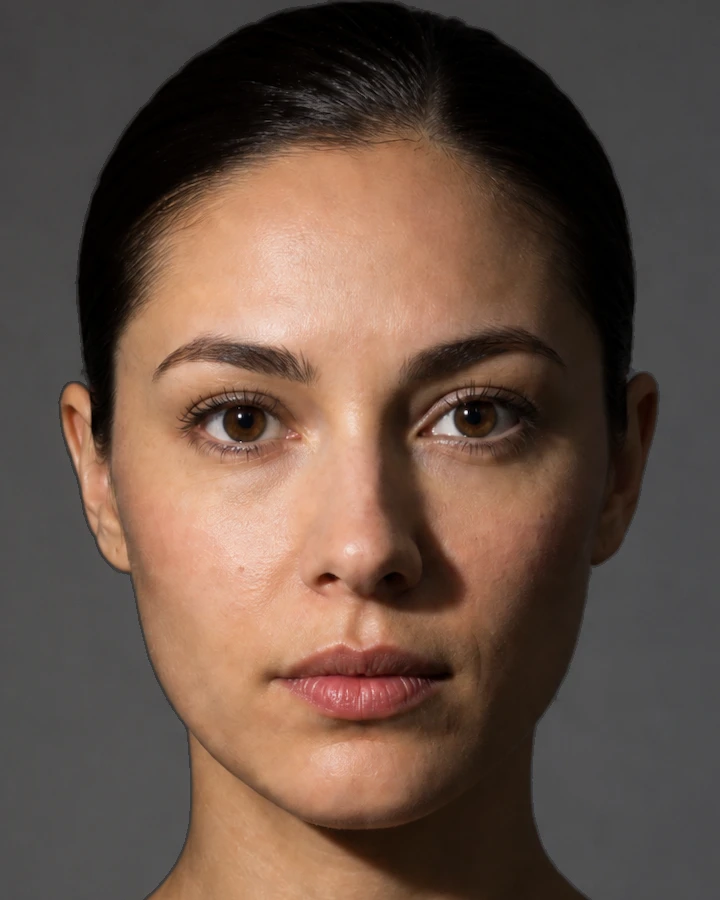
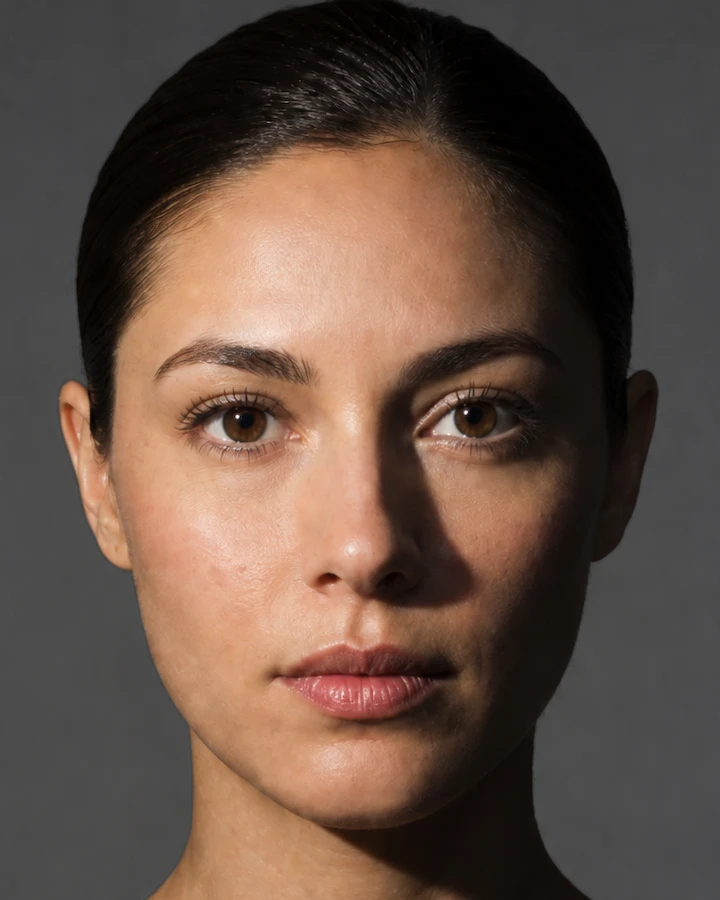
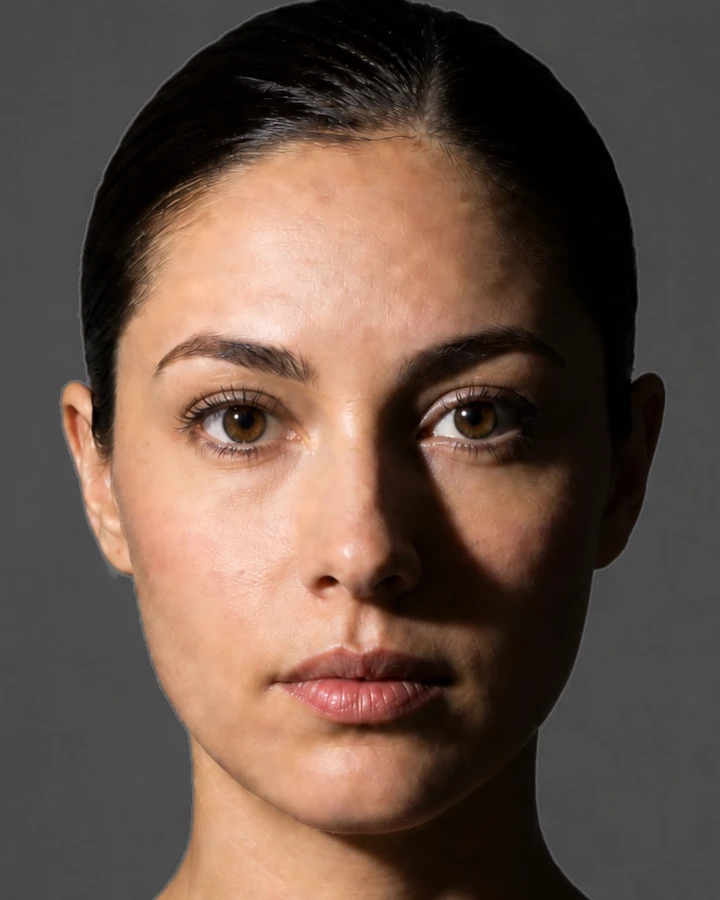
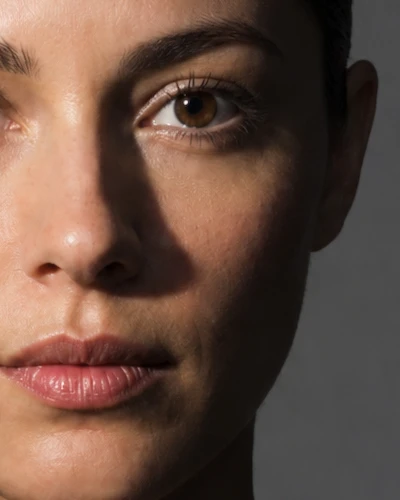
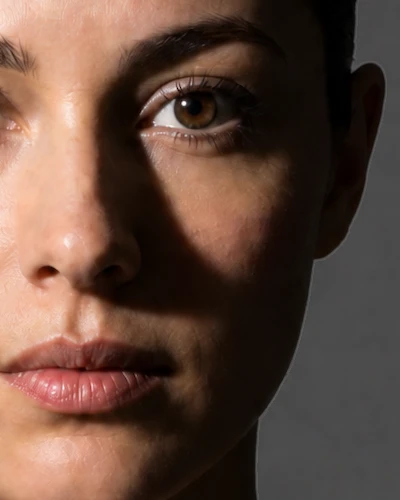
Five views of the same woman’s whole face, lit by one key placed 0.0, 15.8, 27.5, 33.2 and 39.1 degrees off the lens axis to camera-left. In the first she is lit from straight in front: a short shadow directly under her nose, and no cast shadow on either cheek. In the second and third a shadow has appeared down her camera-right cheek and the nose shadow has begun to run sideways toward it, with lit skin still running between the two. In the fourth the two are almost touching. In the fifth they have joined, and the light left on her camera-right cheekbone is an isolated patch surrounded by shadow.

Key 0.0° off-axis

Key 15.8° off-axis

Key 27.5° off-axis

Key 33.2° off-axis

Key 39.1° off-axis

One woman, one key, one key height. In order, the key stands 0.0°, 15.8°, 27.5°, 33.2° and 39.1° off the lens axis to camera-left — every figure measured off the frames you are looking at, not read off a stand. Watch her camera-right cheek. In the first frame the only shadow on that face is the short one under her nose, and that cheek carries no cast shadow at all. By the last, the nose has laid its shadow sideways across the cheek to meet the shadow already waiting there, and the light left on her cheekbone is cut off from the lit side of her face. Every name photographers give this light is a region of that one movement, and the borders between them are the moments two shadows touch.

One shadow, then two, then one again

Start with the key square to the lens. There is exactly one shadow on that face: a short one under the nose, going nowhere, and no cast shadow at all on the far cheek. Walk the key round and a second shadow appears — not cast by anything, but the far side of the face simply turning away from the light. From that moment the whole story of portrait lighting is the strip of lit skin between those two shadows, and what happens to it.

It never switches off. It closes. Measured on the frames above, the darkest point along that connecting strip sits 0.72 stops below her lit cheek at 15.8° off-axis, 1.64 at 27.5°, 2.81 at 33.2°, and 6.83 at 39.1°. One direction, no reversals. Loop is the part of that walk where the strip is still comfortably open; Rembrandt is what you call it once the strip has shut and the light stranded on the far cheekbone has become an island.

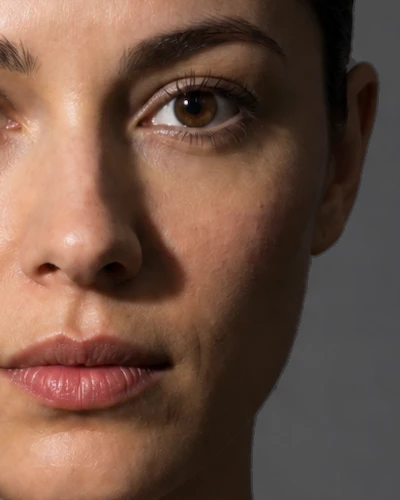
Three tightly cropped views of the same woman’s face, running from the bridge of her nose across her camera-right cheek to her jaw, with the key 27.5, 33.2 and 39.1 degrees off the lens axis to camera-left. In the first two the shadow cast by her nose stops short of the shadow on that cheek and lit skin still runs between them. In the third the two shadows have met, and the light on her cheekbone is an isolated patch with shadow all round it.

Key 27.5° off-axis

Key 33.2° off-axis

Key 39.1° off-axis

The same walk, three of its positions, at the magnification where the ending is decided: the key at 27.5°, then 33.2°, then 39.1° off the lens axis to camera-left. Follow the light between the nose shadow and the shadow on her camera-right cheek. In the first two it still runs from her lit side out to that cheekbone. In the third it does not: the two shadows have met, and what is left on the cheekbone is an island. That closure is the event the names turn on, and it is the one test on this page you can apply to a photograph whose stands you never saw.

What ends a loop

Two shadows meeting. That is the entire test, and it is the one you can apply to a picture on a screen with no idea where the stands were.

Which means the boundary moves. It moves with the key's height: raise the key and the two shadows meet at a smaller angle. That is not a theory — it is the difference between the two setups at the foot of this page, one loop and one Rembrandt at the same 45°. It moves with the face, because a nose that projects further throws a longer shadow and closes the gap sooner. And it moves with how large and how close your source is, because a soft transfer edge turns the moment of contact into a range rather than a line.

None of that makes the pattern vague. It makes the number useless and the shape decisive. Set the light by watching the shadow-side cheek, not by reading a floor mark: the last frame before the two shadows touch is a loop, and the first frame after is a Rembrandt, wherever on the floor that happens to be for the person in front of you.

Keep walking past the end of this page — past 39.1°, on toward edge-on — and the far cheek goes dark altogether and the nose shadow stops being a shape you can trace at all. When you can no longer find the nose shadow as its own object, the key has arrived at split. These five frames stop short of that; the split entry carries its own.

The eye keeps the same record

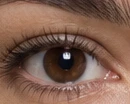
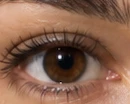
Three very tight views of the same woman’s lit eye, one for each of three key positions: 0.0, 27.5 and 39.1 degrees off the lens axis to camera-left. In the first, the small bright reflection of the light sits directly above her pupil. In the second it has moved round toward the side of the iris nearest the light. In the third it is further round and further out from the centre again, while staying at very nearly the same height in the eye.

Key 0.0° off-axis

Key 27.5° off-axis

Key 39.1° off-axis

The same walk, read in her lit eye: the key at 0.0°, then 27.5°, then 39.1° off the lens axis to camera-left. The first frame sets the zero. A sitter’s own fixation puts several degrees of error into any absolute reading of a reflection on the cornea, so that first catchlight is called 12:00 by definition, and what the others give you is the movement away from it — 9:56 in the second. By the third the clock face has stopped telling positions apart and started running backwards, so that one is given instead as a fraction of the way from the centre of the iris to its edge: 0.43, further out than either frame before it. Across all three the reflection travels sideways and barely changes height. That is the walk’s promise made visible — one key height, held, while only the position round her face changed.

A catchlight is the key light's own reflection — the one place in a portrait where you see the source instead of its shadow. Take three of the five positions and it travels sideways across the iris, from directly above the pupil round toward the side nearest the light, and it barely changes height while it does it. That constant height is the walk's promise made visible: the key's elevation was held, and only its position round the face changed.

This is also why a catchlight's position is worth reading and its shape is not. Position tells you where the light is. Shape tells you the outline of the modifier — a rectangle for a softbox, a ring for a beauty dish — and a rectangle in the eye tells you nothing whatever about whether that softbox is at 15° or at 40°.

What people get wrong

Trusting the degrees. Every published figure for these patterns is somebody's average subject at somebody's key height. Our own two 45° setups are the counter-example, and they are both correctly named. A photographer who sets 45° and stops looking has outsourced the decision to a number that cannot see the face.

Reading brightness instead of geometry. The connecting strip does not fade away and leave a loop behind; it closes, and the name changes the instant it does. Level and topology are different quantities. It is worth saying plainly, because the frames on this page are deliberately not exposure-matched — her lit side varies by 0.37 stops across the five — and a reader who compared faces by how bright they look would be reading the one thing here that is not the variable.

Turning the head instead of moving the light. They are not the same operation. Moving the key changes which planes of the face are lit. Turning the sitter changes that and changes which side the camera sees more of, which is the broad-versus-short decision and a separate axis entirely. This page holds the face square to the lens on purpose, so that only one thing is moving.

Assuming equal moves of the light do equal things. They do not, and the ladder above says so. Taking the key from 15.8° to 27.5° — nearly twelve degrees — cost the connecting light 0.92 stops. The last step, 33.2° to 39.1°, is half that distance and cost 4.02 stops. The nearer you are to the moment the two shadows meet, the more a small move is worth. That is the whole felt difference between loop, which tolerates a clumsy stand, and Rembrandt, which does not.

In the library

Two measured setups, one key angle, two pattern names:

And the regions this walk passes through: butterfly, loop, Rembrandt, split, and the light doing the walking — the key light.
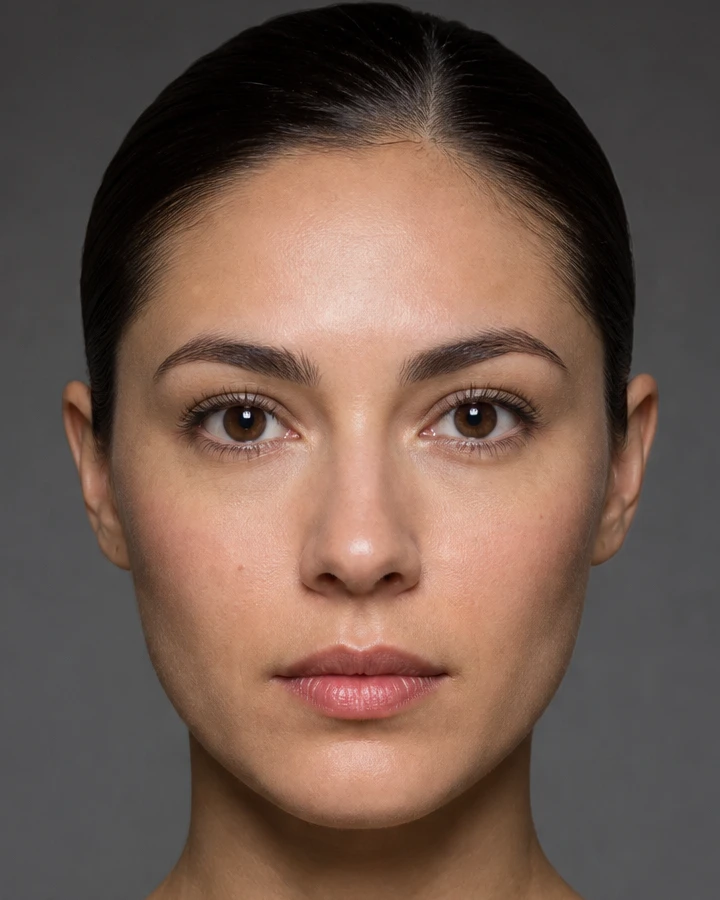
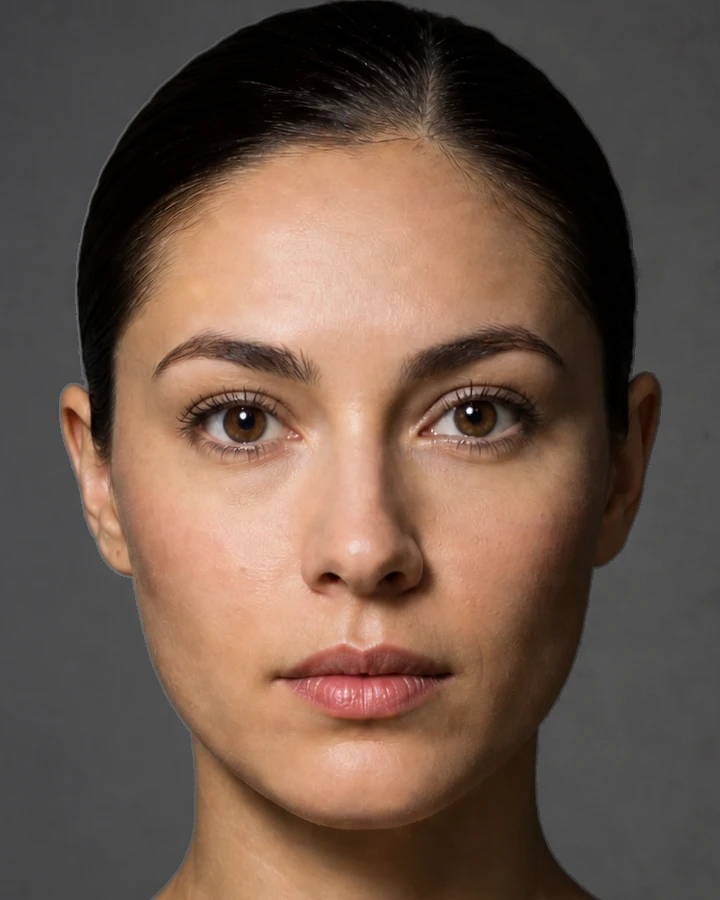
Seen in these setups

Setups from our library that demonstrate pattern walk — measured rather than asserted.

Keep reading