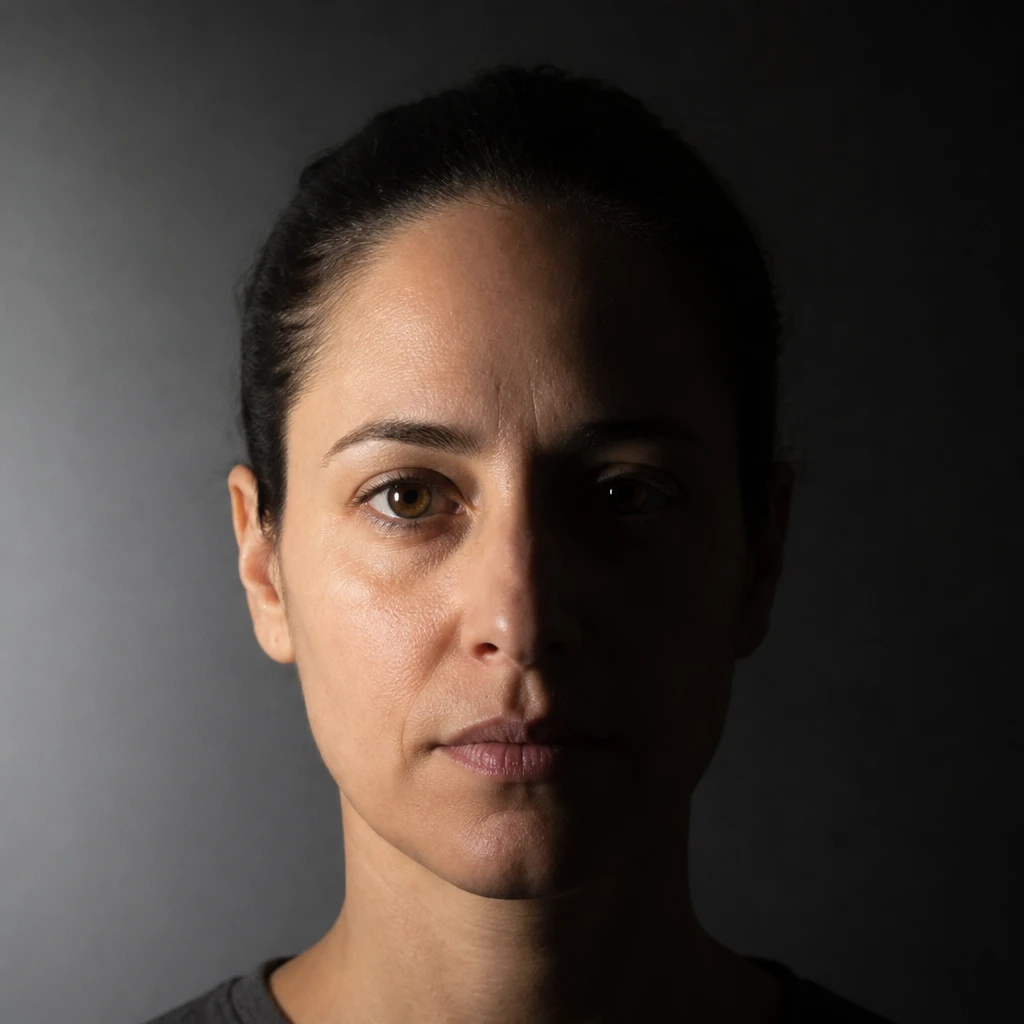
Split lighting is a single key taken all the way around to the side of the face — edge-on, level with the eyes — until the light stops wrapping and simply stops. One half of the face is lit, the other falls away into shadow, and the border between them runs vertically down the middle: brow, bridge of the nose, philtrum, chin. It is the end-stop of the classic patterns, the place the key arrives at when you keep walking it past Rembrandt, and the least forgiving light in portraiture.
When to reach for it
Split is a decision, not a default. It halves a face, so it suits subjects who can carry that: musicians, fighters, character studies, anyone whose portrait is meant to withhold something. It is the light of noir and of the album sleeve, and it works because the viewer is given one eye to meet and one to guess at.
Its cost is that it flatters nothing. Every irregularity along the centre line — a bent nose, an asymmetric brow, uneven skin on the lit cheek — is raked by the light and enlarged. Frontal patterns forgive; split reports. That is the whole reason to use it, and the whole reason not to.
How to identify it in a photograph
Find the boundary and follow it. In a true split it is a terminator — a shading boundary that belongs to the form, curving with the brow ridge, breaking around the nostril, softening under the lip. It crosses the face from top to bottom without interruption, and both eyes stay in frame with only one of them lit.
Then look at what the nose shadow is doing. In loop and Rembrandt it is a shape you can trace — an island, or a wedge closing against the cheek shadow. At split it has nowhere left to go: it merges into the shadow half and stops being a separate feature at all. When you can no longer find the nose shadow as its own object, the key has arrived.
The eyes tell you how far round the light really is. On the lit side there is a catchlight hard against the outer edge of the iris, near the limbus rather than near the centre.
The shadow-side eye is the finer gauge. At a true ninety degrees it gets nothing at all. Short of that it keeps a sliver — and how far that sliver sits from the outer rim tells you how far forward of square the key still is. Clinging to the rim, and you are nearly edge-on. Sitting well inside the iris, toward the nose, and the light is meaningfully forward of ninety. A full, round catchlight in both eyes means you are not looking at one light at all.
What people get wrong
Confusing a terminator with an edge. Darkening half a face in post produces a straight boundary that ignores the nose, the lip and the brow. Real side light cannot do that, because the boundary is where the surface turns away from the source, and a face is not a plane. If the border is straighter than the face, the light is fictional.
Expecting a head shadow on the wall behind. It is the most common request in split-lighting briefs and it is geometrically impossible. With the key edge-on, the subject's shadow is thrown sideways, past the frame — on a normal studio backdrop it lands several metres away, not behind the head. A split portrait with a crisp head shadow on the wall behind the sitter has two lights in it, whatever the caption says.
What the wall does do is carry the same falloff the face does: bright behind the lit side, dropping away behind the shadow side. That gradient is the cheapest honesty check there is. If a face is four stops light-to-dark and the wall behind it is flat, the light in that picture is painted on.
Filling the shadow side to "rescue" it. A reflector at the same angle as the key does not quietly lift the shadow. Because the key is edge-on, a card placed near it sits just past the point where the cornea stops facing the camera, so its reflection lands on the white of the shadow-side eye rather than in the iris — and it can be many times larger than the key's own catchlight. You end up with the brightest glint in the picture sitting in the eye that is supposed to be dark. If the shadow side needs to hold detail, raise the ambient level of the room rather than adding a card: a dim, even environment lifts the floor everywhere without putting a second source in anyone's eye.
Reaching for a hard light because the pattern is hard. The severity comes from the angle, not the modifier. A large softbox placed edge-on gives you a split with a soft terminator, which is usually the more useful picture.