Fashion and location photographers
High-speed sync in daylight
Wide aperture outdoors — balance sun and flash without stopping down.
14 min read

What is high-speed sync?
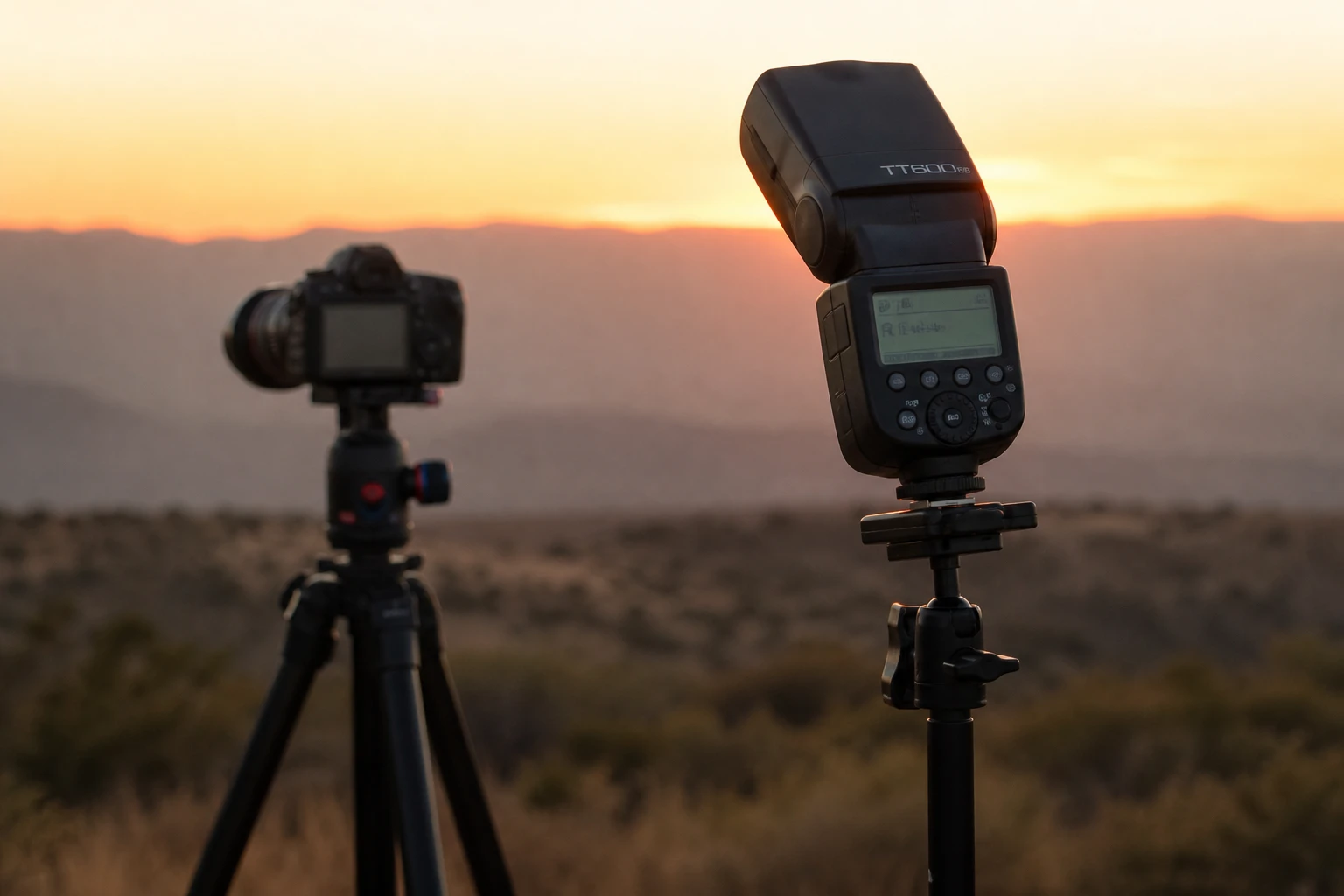
High-speed sync (HSS) lets speedlights or some strobes fire in multiple pulses or extended duration so flash output remains available above camera native sync speed — typically 1/200s or 1/250s — enabling wide apertures in bright daylight without ND filters. Fashion and location photographers use HSS to shoot f/1.4 or f/2.8 at ISO 100 in full sun while flash fills subject face, controlling exposure separately from ambient sky and background blur.
Without HSS, shutter above sync speed causes black band from shutter curtain blocking flash — sync speed caps ambient control. HSS trades flash power efficiency for shutter freedom — power drops significantly versus normal sync — but shallow depth isolates subject from cluttered location. Sunset portraits use HSS to balance golden sky at f/2 while flash lifts face shadow.
HSS differs from neutral density filter on lens — ND dims ambient and flash equally unless flash HSS separately; raising shutter darkens the ambient (shorter open time catches less continuous light), and in HSS it also cuts effective flash output because the moving shutter slit catches less of the pulse train — so you add flash power to hold the face. HSS differs from hypersync some strobes offer — implementation varies by brand — test your kit.
Midday fashion on location is the classic HSS problem: you want f/2 for background blur, ISO 100 for quality, and a sky that reads blue not white — only HSS or heavy ND makes that triangle possible with flash fill. Understand that HSS is not "more powerful flash" — it is flash spread across shutter travel — expect two to three stops less effective output. Plan dual speedlights in one softbox adapter or a battery strobe rated for HSS at higher watt seconds when noon f/2 is non-negotiable.
Test your camera flash sync ceiling — some bodies sync to 1/250, others 1/200 — HSS begins above that threshold. Auto FP or HSS icon in viewfinder must be active; forgetting to enable it produces partial black bars at 1/500 that look like equipment failure but are user settings.
HSS eats flash power — if the face is underexposed at f/1.4 in sun, add flash unit or open to f/2 before you blame the camera.
Placement in practice
Off-camera speedlight or strobe HSS capable camera-left or right forty-five degrees — same portrait angles as non-HSS OCF. Assistant holds or stand with sandbag wind — daylight locations windy. Sun behind subject hair rim natural — flash keys face — classic HSS fashion; sun front harsh — flash fills shadow under hat.
Multiple HSS units increase power — dual speedlight same umbrella adapter — rare beginner. Reflector fill sun side when flash only one unit — reflector free HSS preserve flash for key.
Distance flash to subject six feet start — power max or near max HSS midday — check overheating. Closer flash more power efficient inverse square — but harsh small source — softbox on speedlight HSS for beauty location.
Backlit HSS workflow: meter sky for desired blue, set shutter in HSS range, add flash to face until skin separates from sky — sun provides rim on hair and shoulders automatically. Front-lit sun workflow harder — sun flattens, flash must sculpt — rotate subject to put sun at forty-five degrees as kicker, flash as key from opposite side. Open shade under tree: HSS still useful at f/2 when bright sky behind subject competes — flash separates subject from bright bokeh foliage.
Wind and assistants: softbox on HSS speedlight catches wind — sandbag stand, shorten boom, or hand-hold reflector only and bare flash HSS when gusts strong.

Distance and power
HSS power loss two stops or more versus normal sync — manufacturer guides vary — meter face every shutter/aperture change. Shutter 1/2000 f/2 ISO 100 bright sun — flash full power bare may insufficient — dual flash or accept f/2.8. Shutter controls ambient sky exposure — raise shutter darken sky behind subject; flash power controls face — independent creative pair.
Aperture affects flash and ambient both — stopping down f/5.6 needs less flash power but loses background blur — HSS point is wide aperture — keep f/2.8 or wider when possible.
Normal sync low shutter high aperture outdoor — alternative without HSS — different look more ambient flash blend — not wrong, different lesson.
Build exposure table for one location: columns shutter 1/500, 1/1000, 1/2000; rows sky brightness and flash power setting; fill table once, reuse when cloud cover similar. Aperture f/2 versus f/1.4 changes flash distance requirement — closer flash at f/1.4 for same face exposure — depth of field razor thin — focus on nearest eye. Battery drain accelerates in HSS — carry spare packs for hundred-frame fashion walk.
When sky already dark at sunset, HSS less critical — normal sync may suffice at f/2.8 — use HSS where shutter must rise above sync for ambient, not by reflex always.
Raise shutter to darken the sky, raise flash power to hold the face — two separate controls, one creative look.
Fill, spill, and control
Sun is fill or rim when behind subject — flash is key — ratio by flash power and sun angle. No reflector needed if sun rims hair — add reflector shadow side if flash alone insufficient HSS power budget.
Wind diffusion scrim sun on subject reduces sun contrast before flash — hybrid sun scrim plus HSS flash — sun softer rim flash keys face. HSS flash without scrim hard sun plus hard flash — manage angles.
Spill minimal outdoors — sky infinite — control flash direction only. Indoor bright window HSS flash balance window — gel flash to window if mixing.
Scrim sun on subject when HSS power budget tight — softer sun means less flash needed to match contrast ratio on face. Reflector on shadow side preserves HSS flash power for key duty — silver punch in noon shade. Avoid mixing TTL HSS with manual sun metering — pick manual flash power for repeatable walk sequence.
ND filter plus normal sync alternative when single flash insufficient in HSS — stack ND8 on lens, sync at 1/200, full flash power — heavier rig but more flash punch — know both workflows.

What to look for
Sky exposure desired darkness behind subject — raise shutter until sky rich blue not white — face still lit flash. Face not blown flash — histogram skin right — HSS easy to underpower face overexpose sky or reverse.
Hair rim sun clean separation — flash not competing sun rim — rotate subject until sun and flash roles clear. Catchlight flash off-axis visible in sunlit eyes.
Sync failure black band edge frame — HSS not enabled or flash incompatible — band immediate retake fix.
Common mistakes
HSS enabled expecting same power normal sync — underexposed face — max power, closer flash, wider f-stop compromise, or add second unit.
Shutter at sync speed 1/250 f/1.4 ISO 100 noon — entire frame white overexposed ambient — HSS requires high shutter for sun control at wide aperture — raise shutter into HSS range.
On-camera direct HSS noon — raccoon flat — move off-camera, soften modifier, respect sun angle.
Forgot flash HSS mode on one unit multi-light — band or uneven — all units HSS capable and enabled.
Underexposing face to save sky then lifting face in post — noise in shadows — expose face correctly, accept slightly hot sky or bracket for composite if client demands both. Shooting HSS wide open without checking focus — missed focus at f/1.4 ruins session — back-button focus on eye, verify every wardrobe change.
Using HSS indoors unnecessarily drains battery when sync speed already allows f/2.8 at base ISO — HSS is for bright ambient constraint, not default flash mode.
Try it yourself
Walk the setup one light at a time, or dial passes live in the relight studio.