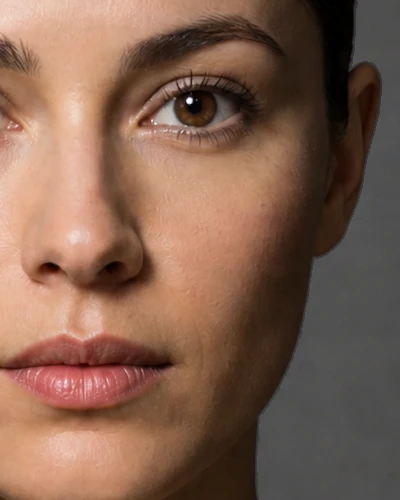
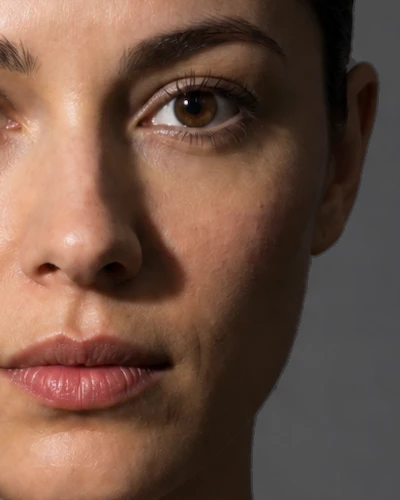
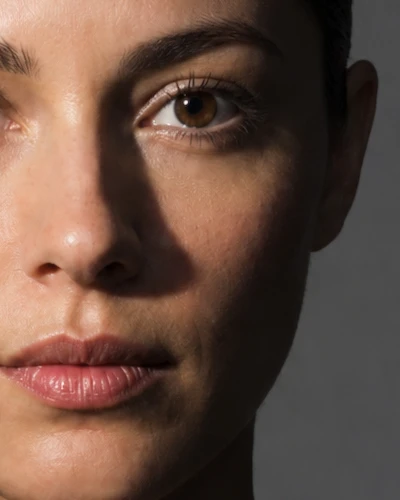
Loop lighting is the key moved a little to one side of the camera — roughly 25–50° — and lifted just above the eye line. Not much of either. The signature is a small, closed shadow that the nose casts down and toward the shadow-side cheek: a "loop" that hangs off the nostril and stops, never reaching the cheek's own shadow. It is the workhorse pattern of portraiture — enough modelling to give the face shape, not enough shadow to cost you either eye.
When to reach for it
Loop is the default answer. Corporate headshots, family portraits, most editorial faces — anything that needs dimension without drama. It flatters nearly everyone because it models the nose and cheek while leaving the whole face readable. Choose something else only when you want an extreme: flat glamour symmetry (butterfly) or weight and mystery (Rembrandt).
How to identify it in a photograph
On our loop reference, everything the pattern claims is measurable:
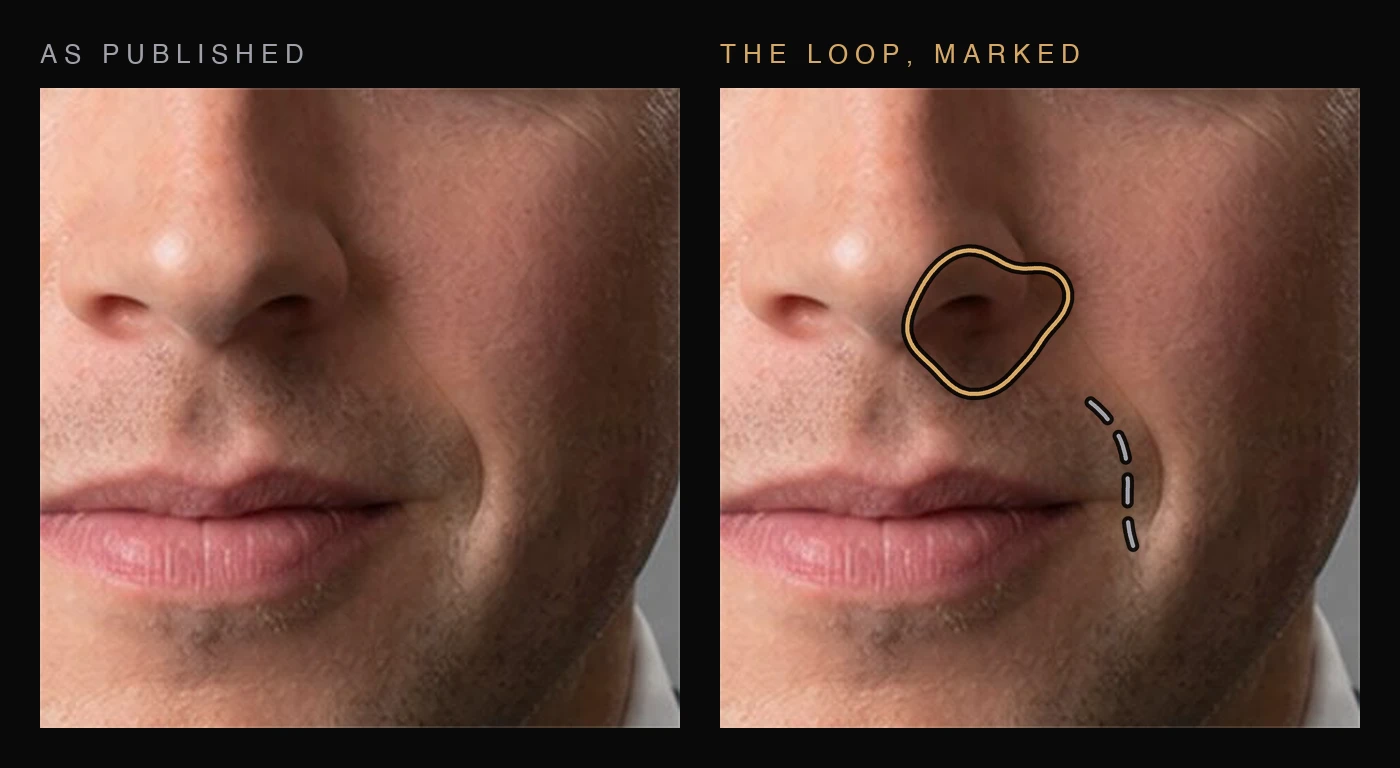
The loop itself. Beside and just below the nostril on the shadow side there is a compact dark shape — about a third of an eye-width across — angled down toward the corner of the mouth. On skin it runs 2.5 to 3.5 stops below the lit cheek: dark enough to read as a distinct shape, nowhere near black.
It stops. This is the whole definition. The shadow ends in lit skin about a quarter of an eye-width above the mouth's corner, and the cheek beside it recovers by about 3 stops within a third of an eye-width — skin to skin. The shadow is an island. The moment it touches the far cheek's shadow, the pattern has become Rembrandt.
A word on that number, because it is easy to get wrong and we got it wrong here first. Point a meter at the nostril itself and you will read seven or eight stops down — but that is a hole, not a shadow, and every cavity on a face reads like that under any light. Measure the shadow where it lies on skin, or you will describe a pattern by the darkness of an opening that would be dark whatever you did.
The shadow side stays open. The far cheek sits only 1.7 stops under the lit cheek — about 3:1 — so both eyes, the brow, and the jaw all stay readable.
The catchlights tell you everything. Square, hard-edged, and sitting well out toward the edge of the iris on the key side rather than near its centre: square because the softbox is square, out toward the rim because the key is off-axis. Two facts readable from a thumbnail — the shape names the modifier, the distance from centre gives you the angle.
Note which of those two is which. A catchlight's shape tells you what the light was; its position tells you where the light was. Reach for a clock face only when the key is close to the lens axis — once it has swung well round, how far the reflection sits from the centre of the iris is the reading that keeps meaning something.
What people get wrong
The smile crease is not the loop. On any smiling subject the nasolabial fold reads dark, and it points the same way the loop does. They are separate shadows with lit skin between them — in our reference the gap recovers by more than a stop before the crease begins. Trace them as one line and you will call a loop a Rembrandt. Find the light gap before you name the pattern.
Rotating or raising too far. Walk the key further around, or lift it toward 45°, and the loop stretches until it welds onto the cheek shadow — Rembrandt, arrived at by accident. Loop wants the key just above the eyes; our reference measures 8–14° above the eye line, which is what "slightly above" means in numbers.
Coming back too frontal. Drift the key toward the lens and the loop shortens, straightens, and centers under the nose — you have made butterfly. One control, the horizontal angle, walks the whole sequence: butterfly → loop → Rembrandt → split.
Hardening the edge by distance. Here the shadow edge rolls from dark to lit across 12–14mm of skin because the softbox is large and close. Pull it back and the same geometry cuts like a knife, and the gentle loop reads as a cut-out.
Honest limitations
The key's height is not recorded in this setup's data; the 8–14° figure is measured from the catchlight reflections and is good to about ±6°. The setup also lists an optional white bounce card that cannot be confirmed from this photograph — the open shadow side is equally explained by the softbox's own wrap, so we do not claim the card is visible.
In the library
One verified demonstration: Soft One-Light Headshot — endorsed by measurement on all four loop discriminators, with the key at ≈45° camera-left confirmed by two independent instruments.