Take Light Off, Not Down
Flagged Key White Shirt Portrait
Lighting setup
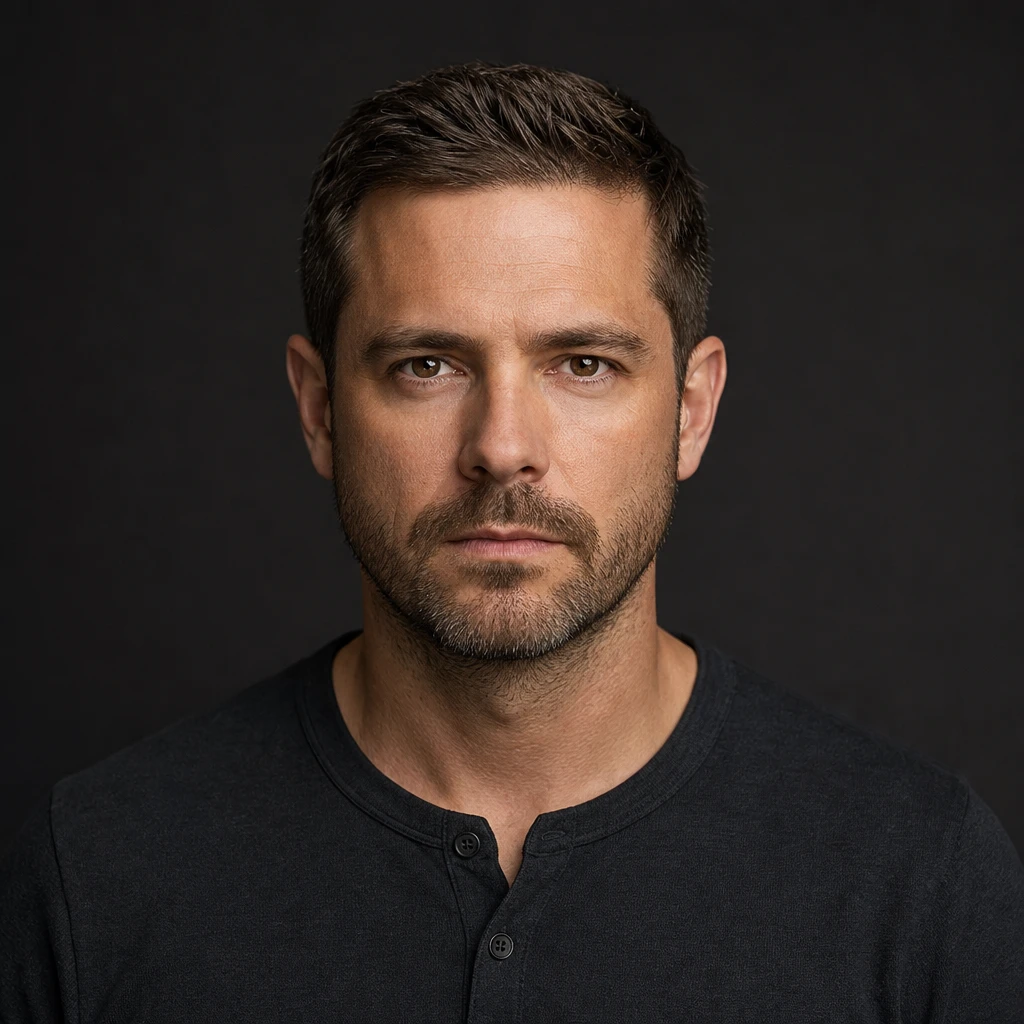
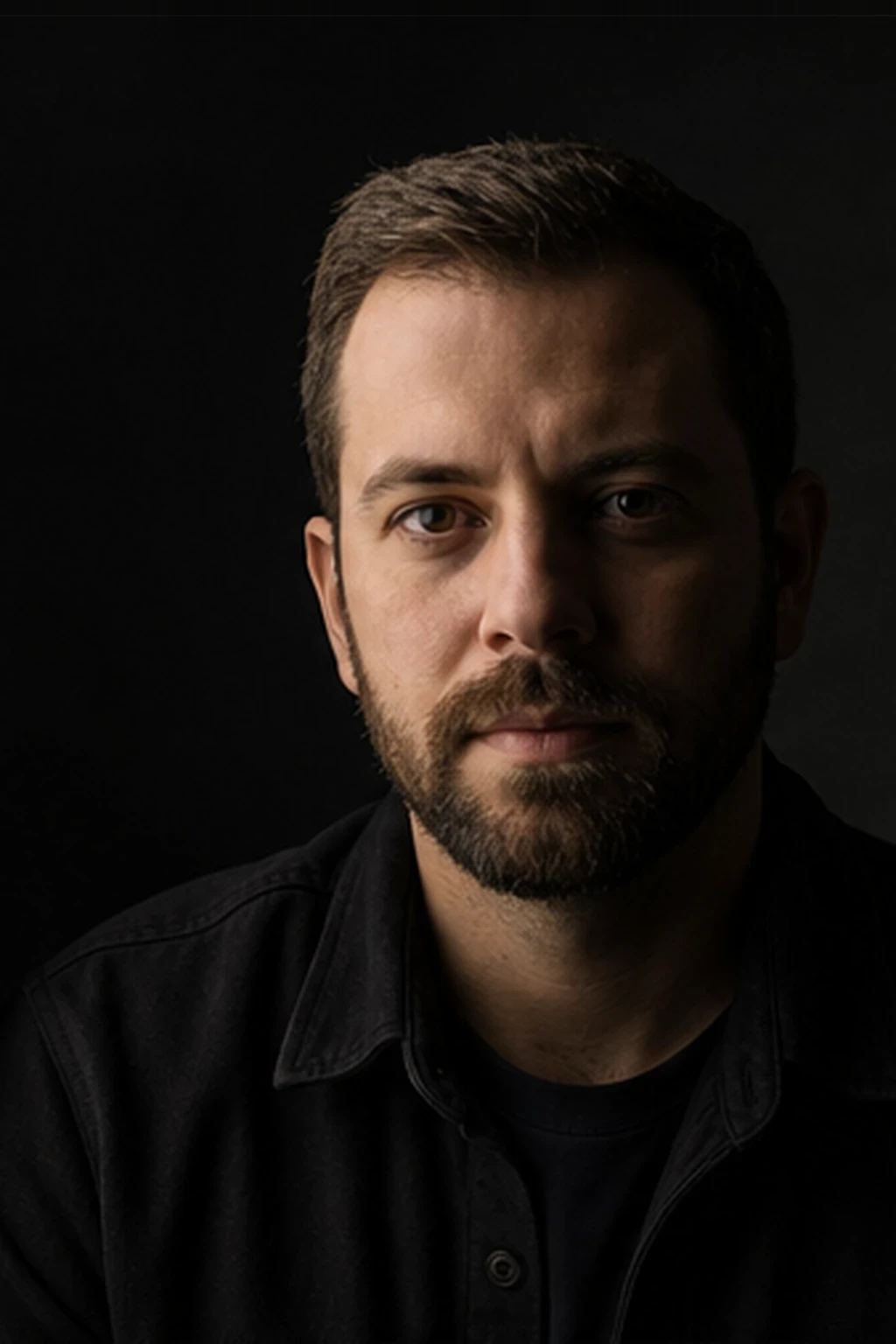
A man in a crisp white cotton shirt, open at the collar, against a dark grey wall. A large softbox from camera-left lights his face fully, while a black flag hung under the box takes some of that light off the shirt — so the brightest thing in the frame keeps its weave, seams and fold shading, and darkens smoothly by about a stop and a half from collar to waist. A white board at camera-right opens the shadow side and shows as a small second catchlight.

Flag the light off the shirt; leave the face alone.
Learning path
This setup appears in curated assignments — continue the sequence when you are ready.
Black does not only deepen a cheek. Hang a flag under the box and it takes light off the white shirt while the face keeps all of it — the brightest thing in the frame is protected without touching the power.
- Lights
- 1
- Contrast
- About 2:1 across the face (≈1 stop)
- Catchlight
- One rectangular catchlight high on the left of each iris (about 10–11 o'clock), plus a smaller, dimmer one on the right from the white board
- Key position
- Large softbox about 45° camera-left, a little above eye level, with a black flag under it
- Technique
- Key light
- Mood
- Commercial
- Quality
- Soft Light
- Subject
- Male Portrait
- Environment
- Studio / Dark Background
Mood variations

Flag Out
Take the black flag away and leave the softbox and the board where they are. The full box now reaches his chest, so the shirt brightens most toward the waist, where the flag had cut the most, and about a quarter of it clips to white; his face sees the same box as before and does not change.
Final look
Base setup
White cotton reflects far more light than skin, so a key set for the face puts the shirt at the edge of clipping — and the darker the skin, the wider that gap. Turning the key down would darken the face with it. A flag does what a dimmer cannot: it takes light off one part of the frame and leaves the rest alone. Hung under the softbox and close to it, the flag hides part of the box from his chest; because it sits near the source, its shadow edge is wide and soft, so the shirt falls off gradually instead of carrying a line. His face still sees the whole box — the uncut catchlight shows it — so its exposure does not change.
Camera & framing
ISO
ISO 100
Shutter
1/200s
Aperture
f/5.6
Exposure
Lens
85mm
Camera height
Eye level
Framing
Head to mid-torso against the wall
Lens & framing
Key notes
- 1Set the softbox for the face first: about 45° camera-left, a little above eye level.
- 2Read the shirt on the histogram or the highlight warning, not the screen — white cotton clips long before skin does.
- 3Hang a black flag under the box, close to the box, and raise it until the shirt drops below clipping. Near the box its edge is soft; near him it would draw a line across his chest.
- 4Watch the catchlight: when its lower edge starts to cut off, the flag has reached the face — lower it.
- 5A white board at camera-right sets the shadow side; it shows as the small second catchlight.
Gear alternatives
Same lighting job — budget, mid, and pro tools. Highlighted cells match what this setup names.
Soft key
softbox
Soft wrap with controllable edges
- Budget
- Shoot-through umbrella
- Mid · this setup
- Rectangular softbox
Main flash
strobe
Controlled burst power for modifiers and freeze
- Budget
- Speedlight / hot-shoe flash
- Mid · this setup
- Monolight strobe
- Pro · this setup
- Pack + head or high-output strobe
Negative fill / cutter
flag
Kill spill and deepen shadow side
- Budget · this setup
- Black foamcore / cardboard
- Mid · this setup
- Solid flag on stand
- Pro · this setup
- Flag + C-stand / arm
Bounce / block card
foam-board
Cheap fill, flag, or tabletop bounce
- Budget · this setup
- White / black foam board
- Mid · this setup
- Foam board + clamp / stand
Bounce fill
reflector
Lift shadow side without a second lamp
- Mid · this setup
- 5-in-1 reflector
- Pro · this setup
- Large collapsible or frame reflector