The vocabulary's exam: frames to name, one test to run — have the nose shadow and the shadow on the cheek beyond it met? — and a name for every wrong answer. Nothing is scored.
The pattern walk gave you one test. Two shadows — the one the nose casts, and the one on the cheek beyond it — and whether they have met. This page asks you to run it.
Five frames, one question each, and a last pair that answers itself. Nothing is scored and nothing is timed. A wrong answer here is worth more than a right one, because every wrong answer on this page has a name, and it is a name you can carry to your own pictures.
One thing about the option lists before you start. The names in them — butterfly, loop, Rembrandt, split — are not four kinds of light, and they are not a complete list of anything. They are regions of one continuous movement of one key, and they are the regions this library holds entries for. Plenty of good portraits sit between them, or nowhere near any of them.
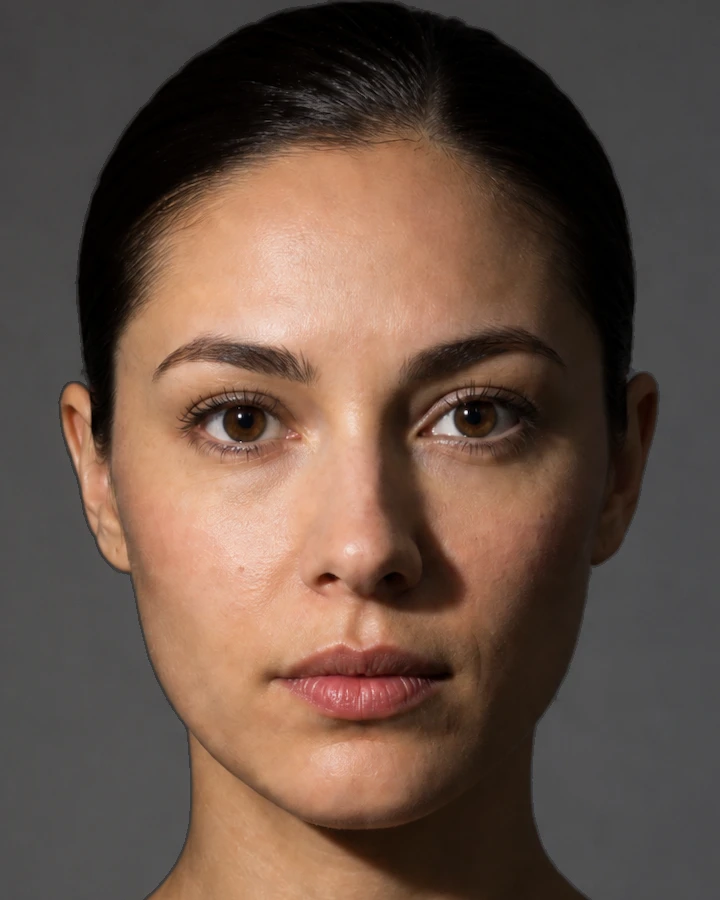
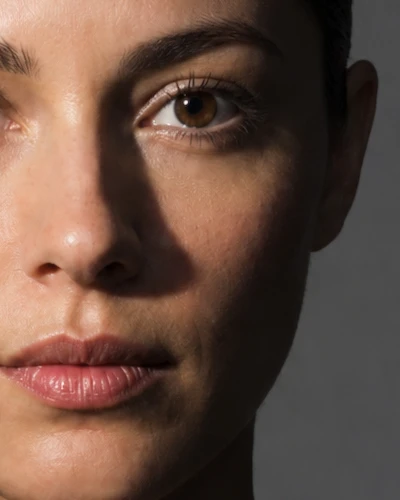
Light comes from the side opposite its shadows, and that is the whole of it. Her nose has laid a shadow toward her camera-right cheek, and that is the cheek carrying the darker side of the face. Both point the same way, so the source is on the other side. You did not need the background, her expression, or how bright the frame is.
Her lit eye keeps the same record. A catchlight is the key’s own reflection — the one place in a portrait where you see the source instead of its shadow — and here it sits round toward the side the light is on, rather than above the pupil.
The key in this frame stands 27.5° off the lens axis to camera-left, measured off the frame you are looking at.
If you chose camera-right, you most likely read the shadow’s position as the light’s position. Reverse it: the shadow is where the light is not.
If you chose “directly above the lens”, that key throws its shadow straight down under the nose and leaves the two cheeks matched. Neither is true here — the shadow has slid, and one cheek is down on the other.
If you chose “you cannot tell”, you can, and from this frame alone. That is the reason a photographer can look at a stranger’s portrait and describe the room it was made in.
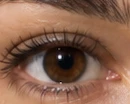
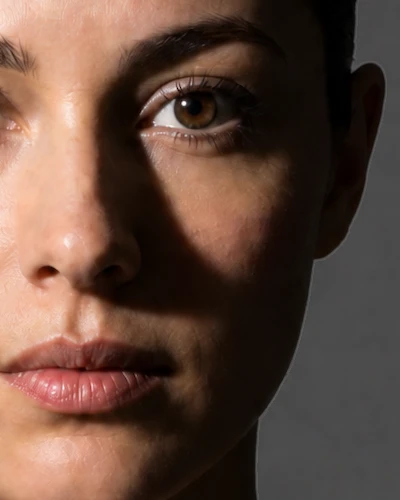
The same frame, her lit eye. The reflection of the source has moved round toward the side the light is on. Read a catchlight’s position; its shape only tells you the outline of the modifier.
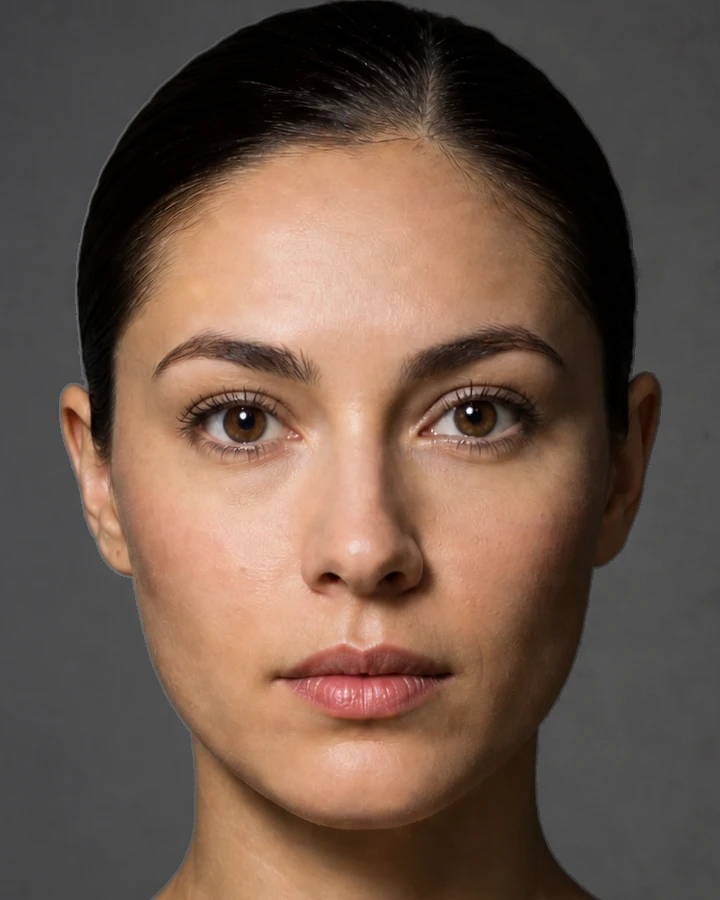
The nose is casting a small shadow down and toward her camera-right cheek, and that shadow stops. There is lit skin between it and the shadow on the cheek beyond. Two shadows on one face, not yet touching: that is the whole of loop.
Now the part that matters. The key in this frame stands 15.8° off the lens axis. Every published figure — including our own loop entry — puts loop at roughly 25–50°. This is a loop more than nine degrees below the bottom of that range, and it is a loop because of what the shadow is doing, not because of where the stand was.
If you chose butterfly, the test you needed is symmetry, and it has to hold everywhere: temple, cheek, jaw, and the base of the nose. Here the nose shadow has already slid off centre and one cheek has started to go down. Fifteen degrees of drift is enough. When the two cheeks stop matching, you are not looking at butterfly.
If you chose Rembrandt, look for lit skin between the nose shadow and the cheek shadow. It is there, and it is wide. Rembrandt is what you call this face after those two have met.
If you chose split, split has no separate nose shadow at all — it merges into a dark half. Both of this woman’s cheeks are lit.
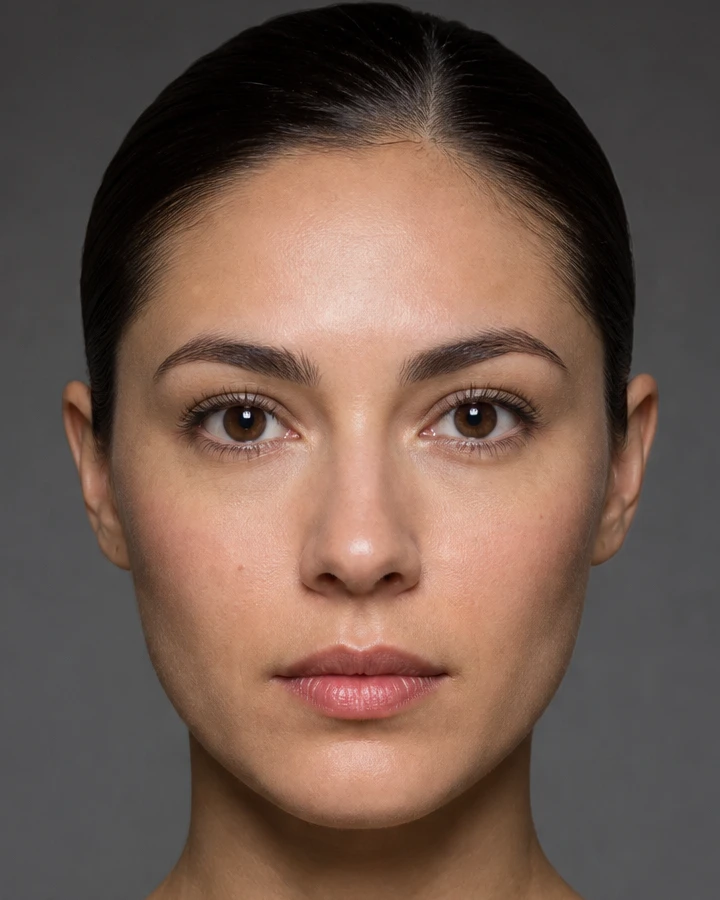
The same face with the key square to the lens: the shadow under the nose is central and neither cheek carries one at all. One shadow, then two — that step is what you just identified.
Follow the light from her lit side outward, under the nose shadow, across to the cheekbone. It is dark, it is narrow, and it is continuous. Dark is not the same as closed.
Measured across the whole frame rather than inside this crop, the darkest point along that connecting light runs 0.72 stops below her lit cheek with the key at 15.8° off-axis, 1.64 at 27.5°, 2.81 here at 33.2°, and 6.83 at 39.1°. Two and eight-tenths stops is deep enough to look shut on a screen. It is not shut.
If you answered yes, you did the thing this whole subject punishes: you read level instead of topology — how dark it is, instead of whether it connects. It is the most common misreading in portrait lighting. The cure is to trace, not to glance.
One position further round, at 39.1°: the two shadows have joined and the light on the cheekbone is an island. That closure is the event the names turn on — everything before it is loop, everything after is Rembrandt.
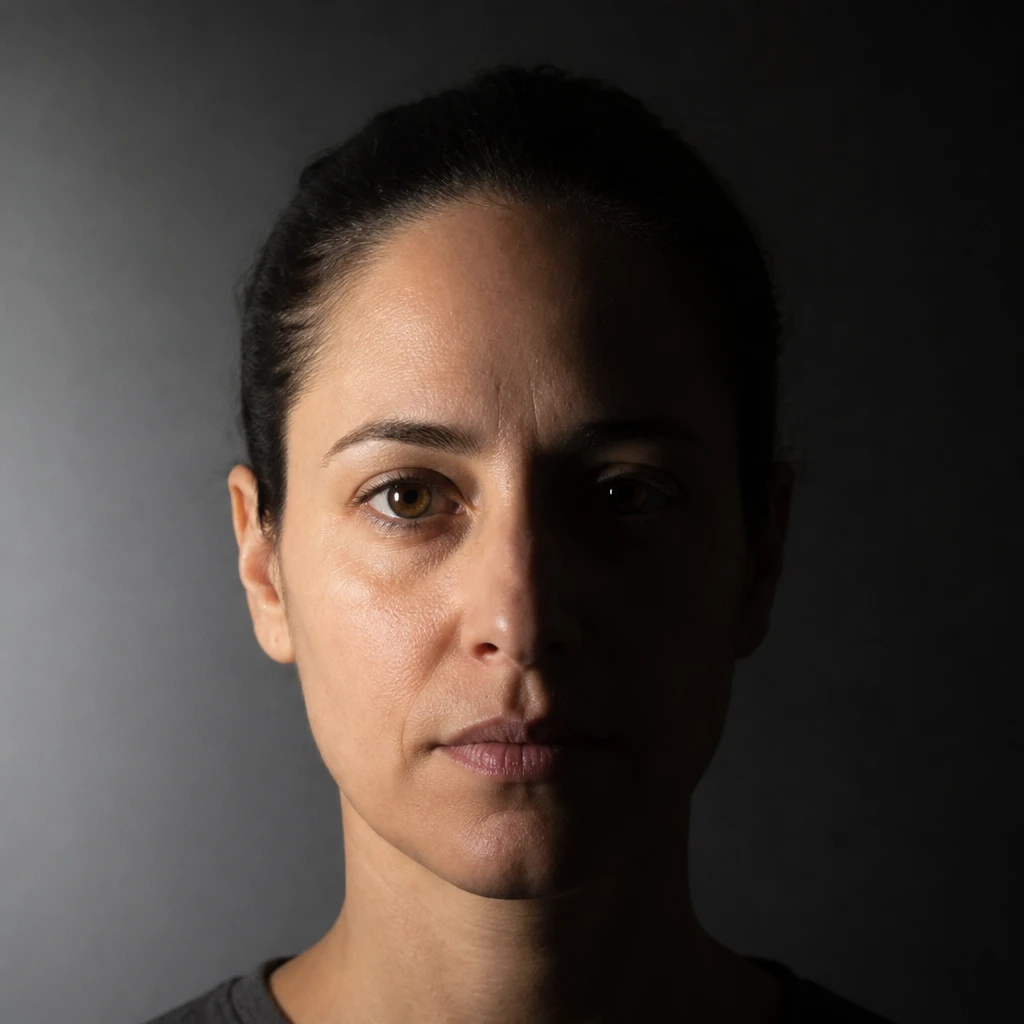
Run the same test and it finds nothing to test. The nose shadow is not a shape on this face any more: it has merged into the dark half, and there is nothing left to trace toward the cheek. When you can no longer find the nose shadow as its own object, the key has arrived at split.
Two further checks agree. The boundary is a terminator — it curves with the brow, breaks around the nostril, softens under the lip — because it is where the surface turns away from the source, and a face is not a plane. And the shadow-side eye keeps only a sliver of the key’s reflection, sitting on the nose side of the iris rather than at its outer edge, which says the key is forward of square rather than fully edge-on.
If you chose Rembrandt, look for the patch. Rembrandt leaves a closed island of light on the shadow-side cheek, fenced in by the nose shadow and the cheek shadow. Here the shadow side keeps nothing at all.
If you chose short lighting, that names which side of a turned head the camera sees more of. It is a decision about the sitter, not about where the light stands, and it can be combined with any pattern here. This sitter is square to the lens, so the question does not arise.
Our split entry explains why this pattern is still a placeholder here: we could not obtain a photograph that survived the checks. It will come down when we shoot the real thing.
Everything so far was one face, one light, moved on purpose. This is a photograph from the library.
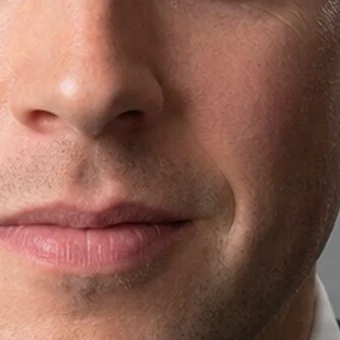
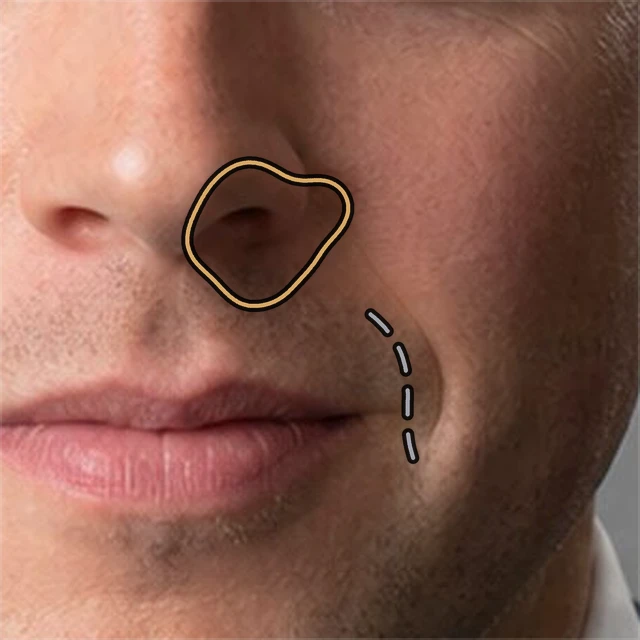
There is a compact shadow beside and below the shadow-side nostril, and further down, separated from it by lit skin, a second dark line running toward the corner of the mouth. They are two different things. The first is the shadow the nose is casting. The second is the crease beside the mouth, which is there whatever the light does.
Trace those two as one continuous shadow reaching the jaw and you have just filed a loop as a Rembrandt. It is the commonest misread in portrait lighting, and it is why the test is does the nose shadow meet the cheek’s own shadow, not is there a dark line on the cheek.
And the number this frame is here for: the key stands about 45° off the lens axis. That is the figure every textbook prints for Rembrandt. This is a loop.
If you chose Rembrandt, you almost certainly joined the shadow to the crease. Look for the lit skin between them; it is marked below.
If you chose butterfly, the shadow is off centre and one side of the face is down on the other.
If you chose split, both sides of this face are lit and the nose shadow is still a shape you can trace.
The frame you were just asked to read, marked. Gold encloses the shadow the nose is casting. The dashed line is the smile crease, which is anatomy and would be there under any light. The unmarked skin between them is the whole answer: join those two into one shadow running down to the jaw and you have filed a loop as a Rembrandt.
One angle, one answer
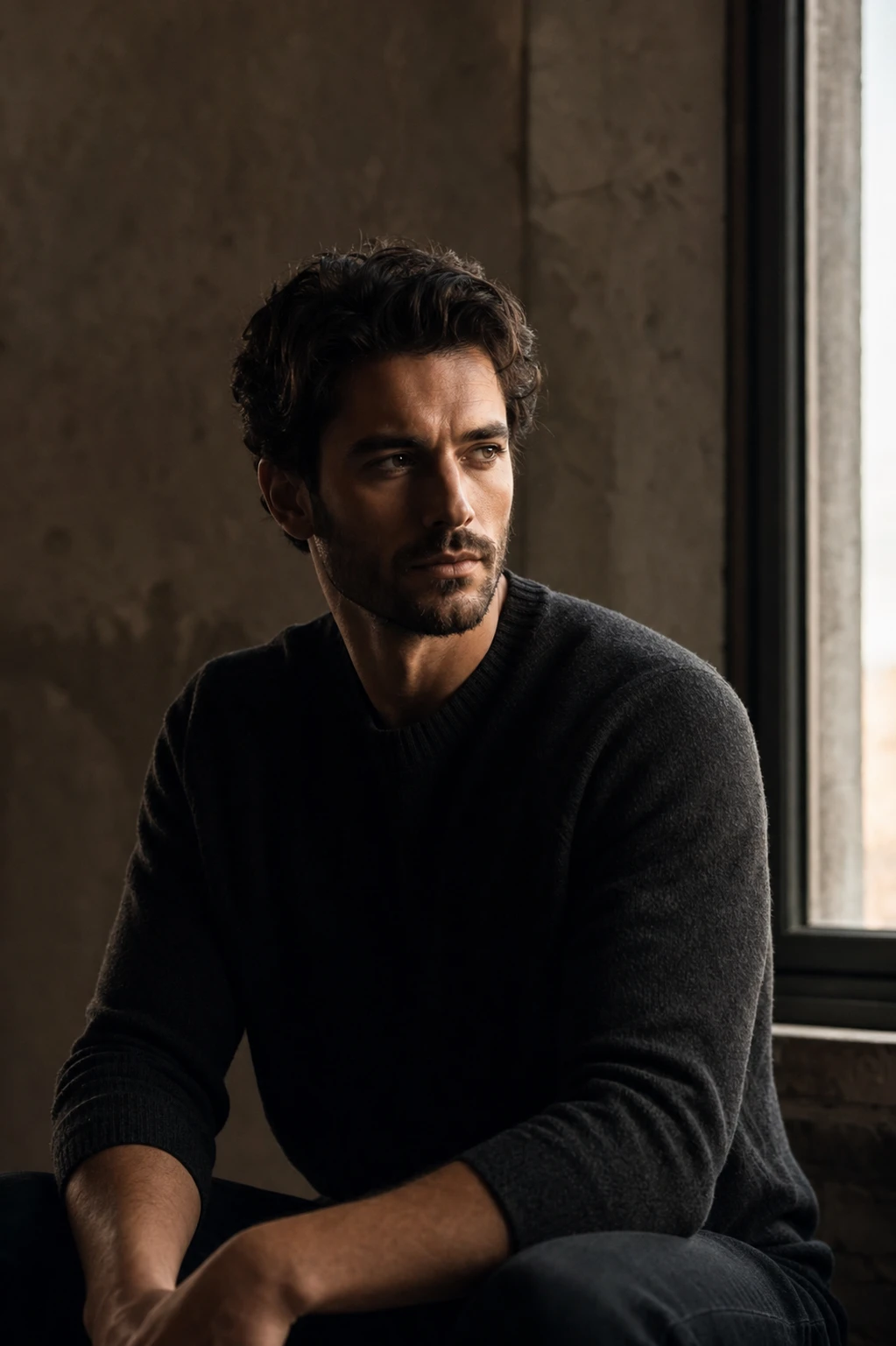
These are the two photographs this library owns at the same key angle. Our own setup records put the first at 45° off the lens axis to camera-left and the second at 45° to camera-right. Run the one test on both, and both give the same answer: the two shadows have not met.
Our loop reference: the key 45° off the lens axis to camera-left and 10° above the eye line, from the setup's own record. A photograph. This is the frame the last question was cut from.Our window portrait: the key 45° off the lens axis to camera-right and 35° above the eye line, from the setup's own record — the textbook Rembrandt position. A photograph, and a different sitter in a different room.
On paper, what separates them is the height of the key: 10° above the eye line on the first, 35° on the second. Raise the key and the nose lays its shadow further down the face, so it reaches the cheek's own shadow at a smaller angle round. That is why the second was set high — and it still has not closed. His key is a whole window, and part of that window sits below his eye line; that low light keeps reaching the cheek the nose should be shading. A record holds one height. A window is a wall of them, and the face answers to all of it.
We are not asking you to see that from these two frames, and you should distrust anyone who says they can. The sitters are different people, the sets are different rooms, and the second man's head is turned well toward his light where the first is nearly square to the camera — three things changed besides the one under discussion. The height figures come from the setups' own records, not from these pictures.
What you can see from them is the answer to the one test, and it is the same twice: two frames at the textbook Rembrandt angle, and neither is a Rembrandt. The closure itself — one face, one key at one height, only its position moving, and the two shadows meeting — is on our Rembrandt entry.
That is the honest state of our evidence. The controlled version — one sitter, one session, one key angle, the light raised a rung at a time — is a session we have planned and not yet shot. When it exists, this panel changes.
What people get wrong
Trusting the degrees. Four of the six frames on this page carry an angle in their explanation, and not one of them is the answer. The loop above was made at the figure every textbook prints for Rembrandt; the loop in the second question was made more than nine degrees below the bottom of every published loop range. A number on the floor cannot see the face in front of it.
Reading brightness instead of geometry. The band of light between the two shadows does not fade away and leave a loop behind. It closes, and the name changes the instant it does. Dark and closed are different quantities, and the third question on this page exists because a band two and eight-tenths stops down looks shut on a screen and is not.
Tracing a crease into a shadow. On any face with expression the fold beside the mouth reads dark and points the same way the nose shadow does. They are separate, with lit skin between them. Read them as one line reaching the jaw and you will file a loop as a Rembrandt — which is the trap the last question is built out of, and it is the commonest misread in portrait lighting.
Treating the page as a test of knowledge. It is not one, and it keeps no score for that reason. If you came here from the pattern walk, three of these frames are ones that page already names — so what is being asked of you there is re-identification, which is a real skill and a different one. The two questions that carry this page are the ones using frames the walk never shows.
In the library
The two photographs the closing panel compares, both keyed 45° off the lens axis: